Turabian Author-Date Style: In-Text Citations & Reference List Guide
Turabian author-date puts the surname and year in parentheses and matches them to a reference list. Page numbers, multiple authors, no date, full examples.
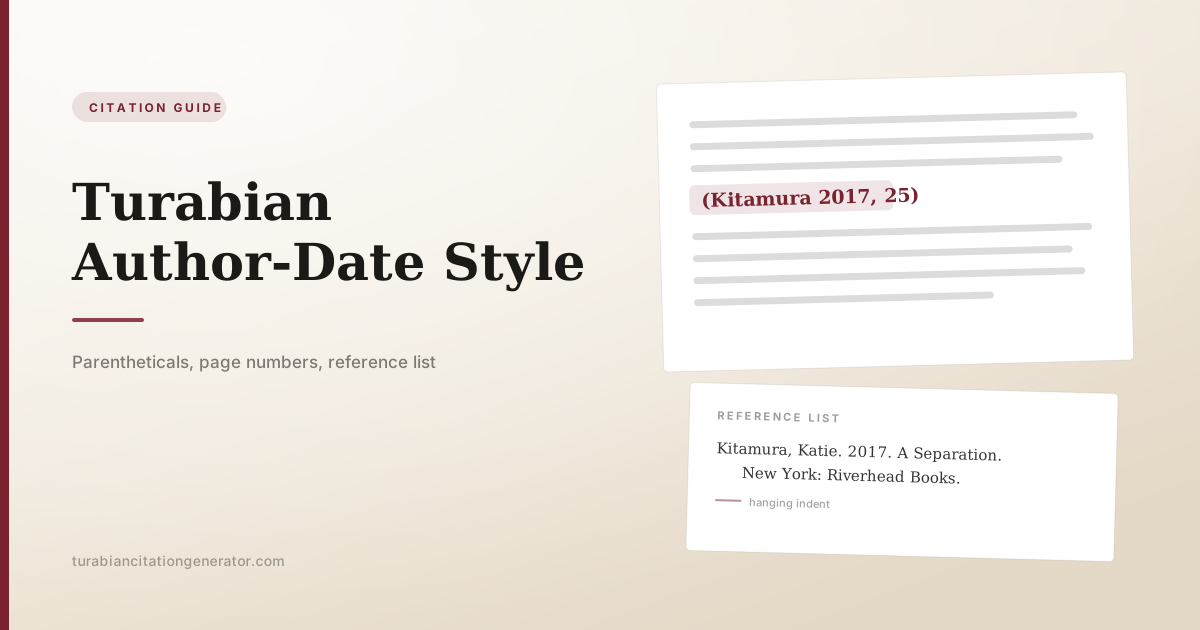
Turabian’s author-date system puts a short parenthetical citation in your sentence and matches it to an alphabetical reference list at the end. The parenthetical carries the author’s surname, the year, and a page number when you need one, with no comma between the name and the year.
In-text citation:
(Kitamura 2017)
With a page number:
(Kitamura 2017, 25)
Reference list entry:
Kitamura, Katie. 2017. A Separation. New York: Riverhead Books.
That is the core of the system. This guide covers the rest: page numbers and other locators, two to ten authors, organizations, missing authors and missing dates, several sources in one parenthetical, two works by the same author in the same year, direct quotation, the reference list for books, articles and websites, and the errors that show up most often in marked papers.
How the two halves fit together
Every parenthetical citation is a pointer. The reader sees (Kitamura 2017), goes to the reference list, finds the entry beginning “Kitamura, Katie. 2017,” and has the full source.
That relationship sets two rules that govern everything else:
- Every parenthetical must have a matching entry. The only routine exception is a personal communication, which is cited in the text and never listed, because a reader cannot retrieve it.
- The entry must begin with exactly what the parenthetical says. If your parenthetical reads (National Endowment for the Humanities 2026), the entry begins with that organization’s name, not with an individual staff author.
Check these two things last, before you submit. A parenthetical with no entry is the most common error in author-date papers, and it is the easiest to catch.
The parenthetical, in detail
Author and year
Surname and year, one space, no comma:
(Lahiri 2016)
In your own sentence, when the author’s name is already there, only the year goes in parentheses:
Lahiri (2016) describes the decision to write in a second language as a deliberate loss of authority.
This reads better and should be your default when the author matters to the sentence. Do not repeat the surname inside the parentheses when you have already used it.
Page numbers and other locators
A comma separates the year from the locator, and there is no p. or pp.:
(Kitamura 2017, 25)
(Keng, Lin, and Orazem 2017, 9-10)
Other locators take a word or an abbreviation:
| Locator | Form |
|---|---|
| Page | (Kitamura 2017, 25) |
| Page range | (Kitamura 2017, 91-92) |
| Chapter | (Austen 2007, chap. 3) |
| Section | (Google 2017, sec. 4) |
| Note | (Perez 2017, 874n12) |
| Table or figure | (Weber et al. 2017, table 2) |
| Timestamp | (Riverbend History 2026, 7:15) |
Use a locator whenever you quote, and whenever a reader would otherwise have to search for the passage you mean.
Two, three and more authors
| Number of authors | In text | In the reference list |
|---|---|---|
| One | (Kitamura 2017) | Kitamura, Katie. |
| Two | (Sassler and Miller 2017) | Sassler, Sharon, and Amanda Jayne Miller. |
| Three | (Keng, Lin, and Orazem 2017) | Keng, Shao-Hsun, Chun-Hung Lin, and Peter F. Orazem. |
| Four or more | (Weber et al. 2017) | List up to ten names |
| More than ten | (Author et al. 2026) | First seven, then et al. |
Note the split: from four authors onward the parenthetical uses et al., but the reference list still names up to ten people. That difference is deliberate, and it is easy to miss.
“Et al.” is roman, not italic, and takes a period on “al” only.
Organizations as authors
Write the organization’s name as it presents itself. Long names can be shortened after the first use if you introduce the abbreviation:
First citation: (National Endowment for the Humanities 2026)
Later: (NEH 2026)
Make the reference list entry begin with the full name and, when you have used an abbreviation, note it so the reader can connect the two:
National Endowment for the Humanities (NEH). 2026. Annual Report 2025. Washington, DC: NEH.
No author
Move the title into the author position, shortened in the parenthetical and given in full in the reference list. Keep the formatting the title would have anywhere else: italics for a book, quotation marks for an article.
(Cambridge Guide 2024, 61)
The Cambridge Guide to Early Modern Trade. 2024. Cambridge: Cambridge University Press.
Do not write “Anonymous” unless the work is genuinely attributed to Anonymous.
No date
Use n.d. in both places:
(Columbia University n.d.)
Columbia University. n.d. “History.” Accessed May 15, 2017. http://www.columbia.edu/content/history.html.
An access date belongs in the reference list entry for an undated source, because it is the only temporal anchor a reader has.
Several sources in one parenthetical
Separate them with semicolons, in whatever order serves your point, most often alphabetical or chronological. Be consistent across the paper.
(Kitamura 2017; Lahiri 2016; Sassler and Miller 2017)
Two works by the same author collapse into one citation with the years separated by commas:
(Lahiri 2016, 2019)
Same author, same year
Add lowercase letters to the year, assigned by the alphabetical order of the titles, and use the same letters in the reference list:
(Raman 2023a, 142)
(Raman 2023b)
Raman, Priya. 2023a. “Objects Without Owners.” Journal of Material Culture 28 (2): 140-58.
Raman, Priya. 2023b. “Reading the Household Inventory.” PhD diss., Northgate University.
Where the parenthetical goes in the sentence
Inside the sentence’s final punctuation, at the end of the clause it supports:
Cohabitation decisions are narrated differently across class positions (Sassler and Miller 2017, 114).
For a block quotation, the parenthetical goes after the final punctuation of the quotation, with no period following it. The thresholds and indentation for block quotations are covered in our Turabian block quotes guide.
Direct quotation
Short quotations sit in your sentence, in quotation marks, with the parenthetical after the closing quotation mark and before the sentence period:
The narrator describes her search as “a formality, and an embarrassing one” (Kitamura 2017, 25).
Always give a page number for a quotation. If the source has no page numbers, use whatever locator it does have: a chapter, a section heading, a paragraph number or a timestamp.
Paraphrase carries the same citation obligation as quotation. The parenthetical goes at the end of the paraphrased material, not at the end of the paragraph, when the paragraph draws on more than one source.
The reference list
The list is headed References, starts on a new page, is alphabetical by the first element of each entry, single-spaced with a blank line between entries, and uses a hanging indent of 0.5 inch. The page-setup mechanics are identical to those in our bibliography format guide; only the internal punctuation differs.
The defining feature is that the year comes immediately after the author, because that is what the parenthetical points at.
Book
Kitamura, Katie. 2017. A Separation. New York: Riverhead Books.
Sassler, Sharon, and Amanda Jayne Miller. 2017. Cohabitation Nation: Gender, Class, and the Remaking of Relationships. Oakland: University of California Press.
Chapter in an edited book
Rowlandson, Mary. 2016. “The Narrative of My Captivity.” In The Making of the American Essay, edited by John D’Agata, 19-56. Minneapolis: Graywolf Press.
Translated book
Lahiri, Jhumpa. 2016. In Other Words. Translated by Ann Goldstein. New York: Alfred A. Knopf.
E-book
Austen, Jane. 2007. Pride and Prejudice. New York: Penguin Classics. Kindle.
Journal article
Perez, Ashley Hope. 2017. “Material Morality and the Logic of Degrees in Diderot’s Le neveu de Rameau.” Modern Philology 114, no. 4 (May): 872-98. https://doi.org/10.1086/689836.
LaSalle, Peter. 2017. “Conundrum: A Story about Reading.” New England Review 38 (1): 95-109. Project MUSE.
Note that the season or month appears in parentheses without repeating the year, because the year is already at the front of the entry.
News or magazine article
Manjoo, Farhad. 2017. “Snap Makes a Bet on the Cultural Supremacy of the Camera.” New York Times, March 8, 2017. https://www.nytimes.com/2017/03/08/technology/snap-makes-a-bet-on-the-cultural-supremacy-of-the-camera.html.
Here the year is repeated in the date, which is deliberate: sources cited by month and day are easier to identify with the full date spelled out.
Website content
Google. 2017. “Privacy Policy.” Privacy and Terms. Last modified April 17, 2017. https://www.google.com/policies/privacy/.
Columbia University. n.d. “History.” Accessed May 15, 2017. http://www.columbia.edu/content/history.html.
Thesis or dissertation
Navarro-Garcia, Guadalupe. 2016. “Integrating Social Justice Values in Educational Leadership: A Study of African American and Black University Presidents.” PhD diss., University of California, Los Angeles. ProQuest Dissertations and Theses Global.
Ordering the list
Alphabetical by surname. For one author with several works, order by year, earliest first. For the same author and year, order by title and add the a, b, c letters. A single-author work precedes a multi-author work beginning with the same name.
A worked ordering example
Here is a reference list containing most of the cases that cause hesitation, in correct order.
The Cambridge Guide to Early Modern Trade. 2024. Cambridge: Cambridge University Press.
Keng, Shao-Hsun, Chun-Hung Lin, and Peter F. Orazem. 2017. “Expanding College Access in Taiwan, 1978-2014: Effects on Graduate Quality and Income Inequality.” Journal of Human Capital 11, no. 1 (Spring): 1-34. https://doi.org/10.1086/690235.
Raman, Priya. 2019. Objects and Owners. Leeds: Northgate University Press.
Raman, Priya. 2023a. “Objects Without Owners.” Journal of Material Culture 28 (2): 140-58.
Raman, Priya. 2023b. “Reading the Household Inventory.” PhD diss., Northgate University.
Raman, Priya, and Marcus Bell. 2021. The Unlisted Collection. Leeds: Northgate University Press.
Sassler, Sharon, and Amanda Jayne Miller. 2017. Cohabitation Nation: Gender, Class, and the Remaking of Relationships. Oakland: University of California Press.
Four things to notice. The untitled-author work files under its title, ignoring “The.” Raman’s three solo works run in year order, with the two 2023 items lettered by title. The Raman and Bell entry comes after all of Raman’s solo works, because a single-author name precedes the same name with a co-author. And each entry begins with exactly the string its parenthetical uses.
Secondary citations
When you want to cite something you have only read quoted in another work, cite what you actually read and show the chain:
(Bell 1974, quoted in Raman 2023a, 148)
Only Raman appears in your reference list, because Raman is the work you consulted. Bell does not, because you did not read it.
Track down the original wherever you reasonably can. Quotations get trimmed and recontextualized as they travel between books, and a secondary citation signals to a reader that you did not check.
Editors, translators and organizations in the author slot
An edited volume as a whole puts the editor in the author position with the label kept:
D’Agata, John, ed. 2016. The Making of the American Essay. Minneapolis: Graywolf Press.
(D’Agata 2016, 19-20)
A translated work keeps the original author in front and names the translator after the title:
Lahiri, Jhumpa. 2016. In Other Words. Translated by Ann Goldstein. New York: Alfred A. Knopf.
Two authors with the same surname are distinguished by initials in the parenthetical, so a reader is not sent to the wrong entry:
(P. Raman 2023a, 148)
(S. Raman 2020, 12)
A reprinted or republished work can give both dates when the gap matters to your argument, with the original date first:
(Rowlandson [1682] 2016, 24)
The reference list entry then leads with the same bracketed original date, so the parenthetical and the entry match.
What stays out of the reference list
Personal communications. Emails, private interviews, text messages and direct messages are cited in the text only:
(Sam Gomez, Facebook message to author, August 1, 2017)
Scripture and other classic sacred works, which are cited by their own internal numbering. See our guide to citing the Bible.
Readers’ comments on articles and posts, which are cited in reference to the original:
(Eduardo B [Los Angeles], March 9, 2017, comment on Manjoo 2017)
Unshared AI conversations, for the same reason: a reader cannot open them. The AI citation guide covers what to do when a public share link exists.
Author-date and notes-bibliography, briefly
Turabian supports both systems, and they are not mixed within a paper.
| Author-date | Notes-bibliography | |
|---|---|---|
| In text | (Kitamura 2017, 25) | A superscript note number |
| End list | References | Bibliography |
| Year position | After the author | After the publisher |
| Typical fields | Sciences, social sciences | History, literature, theology, arts |
The notes side is covered in our complete guide to Turabian footnotes, and the differences between Turabian and its parent manual are set out in Turabian versus Chicago.
Common mistakes
A comma after the author. It is (Kitamura 2017), not (Kitamura, 2017). This is the APA habit.
Writing p. before the page number. The comma already signals it.
Using et al. in the reference list at four authors. The list carries up to ten names; only the parenthetical shortens.
Putting the year after the publisher in a reference list. That is bibliography punctuation.
A parenthetical with no matching entry. Check every one before submitting.
Repeating the surname when it is already in your sentence. Lahiri (2016) is enough.
Using “Anonymous” for an unattributed work. Move the title into the author position instead.
Mixing systems. Notes and parentheticals do not belong in the same paper.
Frequently asked questions
Is there a comma between the author and the year? No. A comma appears only before a page number or another locator.
When do I need a page number? Always for a direct quotation, and whenever you point at a specific passage, table or figure.
How do I cite a source with no date? Use n.d. in place of the year in both places, and add an access date to the reference list entry.
What is the difference between a bibliography and a reference list? The year’s position. A reference list puts it immediately after the author, because that is what the parenthetical points at.
Which system should I use? Follow your instructor or department. Author-date is common in the sciences and social sciences; notes-bibliography in history, literature, theology and the arts.
Before you hand it in
Run one check that catches most author-date errors at once: read down your reference list and confirm that every entry has been cited somewhere in the text, then read through your parentheticals and confirm that every one has an entry. Then look at the punctuation inside three parentheticals at random. If they read (Surname Year, page), the rest are probably right too.
For the entries themselves, enter the author, title, year and publication details into the Turabian Citation Generator and copy out the reference list line.