How to Write Turabian Footnotes: A Complete Guide
Learn how to write Turabian footnotes the right way: number placement, full-note format, book, journal, and website examples, plus common student mistakes.
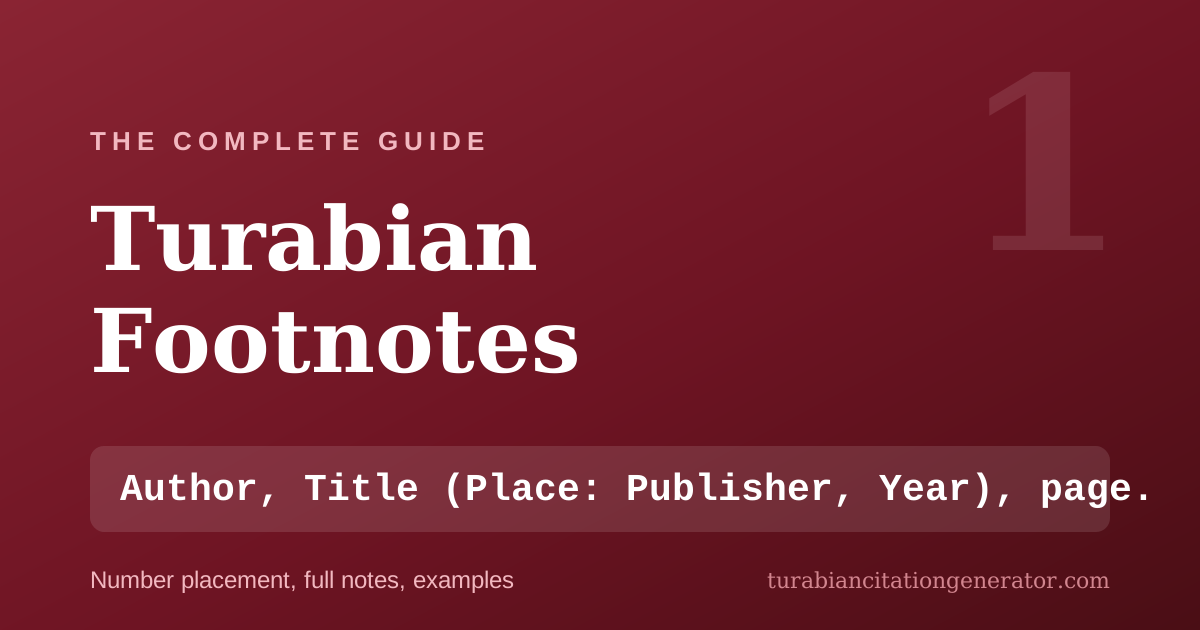
A Turabian footnote is a numbered citation at the bottom of the page that tells your reader exactly where a fact, quote, or idea came from. Every footnote must name the author, the title of the work, the publication facts, and the page you used. You can build a Turabian footnote automatically if you’d rather not track the commas and italics by hand, but it helps to know how the pieces fit together, so this guide walks through the whole system in one place.
Turabian footnotes are part of the notes-bibliography system in A Manual for Writers of Research Papers, Theses, and Dissertations, 9th edition (2018), which is based on the Chicago Manual of Style, 17th edition. If your instructor asked for footnotes, you’re using this system. (Turabian also has an author-date system that uses parentheses in the text instead; you can read a quick comparison of the two Turabian systems on the homepage.) This post covers footnotes only.
What a Turabian footnote must contain
Each footnote does one job: it points to a single source and the exact page. A full note, the first time you cite a source, includes four parts in order:
- Author (first name first)
- Title of the work (italic for books; in quotation marks for articles and web pages)
- Publication facts (city, publisher, and year, usually in parentheses for a book)
- Page number you’re citing
Here’s what that looks like labelled part by part:
Once you’ve cited a source in full, later references use a shorter form. We’ll get to that below.
Where the superscript number goes
In the body of your paper, the footnote marker is a small superscript number placed after the punctuation, after the period, comma, or closing quotation mark. The only exception is a dash, where the number goes before it.
This trips up a lot of students, so here it is both ways:
Right: The reform movement reshaped local politics.¹
Wrong: The reform movement reshaped local politics¹.
The number sits outside the period, tight against it, with no space. One number per note, and the numbers run in the order the notes appear.
Put the marker at the end of the sentence whenever you can, even if the borrowed idea sits earlier in it. A marker mid-sentence is allowed when you need to attach it to one specific clause, but readers expect it at a natural stopping point, so most notes land right after the closing period.
How notes are numbered on the page
Footnote numbers start at 1 and run in a single sequence through your paper (1, 2, 3, and so on), never restarting on each page. Each source gets the next number in line, even if you’ve cited it before.
Two things differ between the marker in your text and the number in the note:
| In the text | In the note | |
|---|---|---|
| Size | Superscript (raised, small) | Full-size |
| Punctuation after | None | A period and one space |
| Example | politics.¹ | 1. Eleanor Hart... |
So a note begins 1. (full-size number, period, space), then the citation.
Place the marker at the end of the sentence or clause the note supports, not in the middle of a thought. If a single sentence draws on two sources, you can cite both in one note, separated by a semicolon:
- Hart, Reforming Century, 61; Blackwood, “Reading the Margins,” 213.
That keeps your numbering clean instead of stacking two markers side by side, which Turabian doesn’t allow.
The book, journal, and website examples
These are the three sources you’ll cite most. Copy the line you need. Each block is a complete, correctly punctuated footnote.
Try it: build a Turabian footnote automatically instead of formatting these by hand.
A book (one author)
Full note
- Eleanor Hart, The Reforming Century (Chicago: University of Chicago Press, 2015), 52.
Shortened note
2. Hart, Reforming Century, 61.
Bibliography
Hart, Eleanor. The Reforming Century. Chicago: University of Chicago Press, 2015.
Notice the book’s publication facts sit in parentheses in the note, and the page comes right after them.
A journal article
Full note
- Susan Blackwood, “Reading the Margins,” Journal of Medieval History 42, no. 3 (2016): 210.
Shortened note
2. Blackwood, “Reading the Margins,” 213.
Bibliography
Blackwood, Susan. “Reading the Margins.” Journal of Medieval History 42, no. 3 (2016): 205–28.
The article title goes in quotation marks and the journal name is italic. In the full note, a colon separates the issue from the page you cite ((2016): 210). The bibliography instead lists the article’s whole page range.
A website or web page
Full note
- Maria Torres, “Preserving Colonial Archives,” National History Center, March 3, 2019.
Shortened note
2. Torres, “Preserving Colonial Archives.”
Bibliography
Torres, Maria. “Preserving Colonial Archives.” National History Center. March 3, 2019.
For a web page, name the author, the page title in quotation marks, the site or sponsoring organization, a date if you have one, and the URL. A shortened web note can drop the page number entirely, since many pages don’t have them.
A chapter in an edited book
When you cite one chapter from a book that has an editor, name the chapter author and chapter title first, then the book (with its editor) in italics.
Full note
- Daniel Okoro, “Trade Routes of the Sahel,” in Empires of the Desert, ed. Priya Nair (New York: Oxford University Press, 2018), 143.
Shortened note
2. Okoro, “Trade Routes of the Sahel,” 147.
The word in connects the chapter to the book, and ed. marks the editor. The page you cite still goes at the end, after the parentheses. Notice the chapter title is in quotation marks while the book title stays italic, the same title rule you saw for articles.
Footnotes with more than one author
The number of authors changes how the note opens. The rest of the note stays the same.
| Authors | Full note opening | Shortened note opening |
|---|---|---|
| One | Eleanor Hart, | Hart, |
| Two | Eleanor Hart and James Cole, | Hart and Cole, |
| Three | All three names, first author first | All three last names |
| Four or more | First author + “et al.” | First author + “et al.” |
Two of those in full:
Two authors (full note)
- Eleanor Hart and James Cole, The Reforming Century (Chicago: University of Chicago Press, 2015), 88.
Four or more authors (full note)
- Priya Nair et al., Coastal Economies (Boston: Harbor Press, 2020), 30.
For two or three authors, list every name in the full note. Once you reach four authors, give only the first name followed by et al. (“and others”) in both the full and shortened notes. The shortened two-author note keeps both last names: Hart and Cole, Reforming Century, 90.
When to switch to a shortened note
The first time you cite a source, use the full note. Every time after that, use a shortened note: just the author’s last name, a short version of the title, and the page.
Full note: 1. Eleanor Hart, The Reforming Century (Chicago: University of Chicago Press, 2015), 52.
Shortened note: 2. Hart, Reforming Century, 61.
To shorten a title, keep the key noun phrase, drop the opening The or A, and drop any subtitle after the colon. So The Reforming Century: Faith and Politics in Early America becomes Reforming Century. Keep enough of the title to tell the work apart from anything else by the same author.
Shortened notes have their own small rules for multiple authors and tricky titles. See our full guide on the Turabian shortened footnote for the details.
If you cite the very same source twice in a row, some instructors accept ibid., an older shortcut that Turabian 9th now discourages in favor of the shortened note. It isn’t banned, and many instructors still allow it. We cover exactly when and how to use ibid. in Turabian in a separate post, and there’s a fuller walkthrough of citing the same source multiple times too.
How footnotes relate to the bibliography
Most Turabian papers have both footnotes and a bibliography at the end. They carry almost the same information, but they’re punctuated differently.
| Footnote | Bibliography entry | |
|---|---|---|
| Author order | First name first | Last name first |
| Separators | Commas | Periods |
| Publication facts | In parentheses | Not in parentheses |
| Indent | First line indented | Hanging indent |
| Page | The exact page cited | Full page range (articles) |
Compare the two for the same book:
Footnote: 1. Eleanor Hart, The Reforming Century (Chicago: University of Chicago Press, 2015), 52.
Bibliography: Hart, Eleanor. The Reforming Century. Chicago: University of Chicago Press, 2015.
The note uses commas and parentheses and points to page 52; the bibliography flips the name, uses periods, and drops both the parentheses and the single page.
The page difference stands out even more with articles. The note gives the one page you quoted; the bibliography gives the article’s whole span.
Footnote: 1. Susan Blackwood, “Reading the Margins,” Journal of Medieval History 42, no. 3 (2016): 210.
Bibliography: Blackwood, Susan. “Reading the Margins.” Journal of Medieval History 42, no. 3 (2016): 205–28.
Same source, two purposes: the note sends your reader to page 210, while the bibliography shows the article runs from page 205 to 228.
Spacing and indentation of notes
Format the notes themselves like this:
- Single-space within each note.
- Leave a blank line between notes.
- Indent the first line of each note half an inch (0.5”), like a new paragraph.
- The note number is full-size, followed by a period and a space.
Bibliography entries flip the indent: the first line is flush left and the following lines are indented (a hanging indent), and the list is alphabetized by the author’s last name. Footnotes and endnotes are simply two places to put these notes: the bottom of the page versus a list at the end. Our post on Turabian footnotes vs. endnotes explains which to choose.
Footnote mistakes that cost marks
A few errors show up again and again. Check your notes against this list before you submit.
- Number before the period. The superscript goes after the punctuation:
...politics.¹, not...politics¹. - Full note every time. Only the first citation of a source is a full note; the rest are shortened.
- Blurring the two systems. Footnotes belong to the notes-bibliography system. Don’t mix in author-date parentheses like
(Hart 2015). - Parentheses in the bibliography. Publication facts sit in parentheses in a note, but not in a bibliography entry.
- Wrong italics. Book and journal names are italic; article and web-page titles go in “quotation marks.”
- Restarting numbers each page. The sequence runs 1, 2, 3 straight through the whole paper.
- Page range in the note. A note points to the exact page you used; the full range belongs in the bibliography (for articles).
When in doubt, match the official Turabian notes-and-bibliography quick guide or the Purdue OWL Chicago/Turabian pages, and follow your instructor’s or department’s guide where they set their own rules.
Turabian footnote questions, answered
Do Turabian footnotes go after or before the period? After. The superscript number sits right after the closing punctuation: the period, comma, or quotation mark. The one exception is a dash, where the number comes before it.
What is the difference between a full note and a shortened note? The full note gives all the publication details the first time you cite a source. Every later citation of that source uses a shortened note: author’s last name, a short title, and the page.
Do I still need a bibliography if I use footnotes? Usually yes. Most Turabian papers include both, and the bibliography lists every source alphabetically by last name. Check your assignment, since a few instructors ask for notes only.
Can I use “ibid.” in Turabian? You can, but Turabian 9th edition prefers a shortened note instead. Ibid. isn’t forbidden, and some instructors still accept it for back-to-back citations of the same source. Ask which your instructor wants.
How do I write footnotes in Turabian for a source with no page numbers, like a website? Cite the author, title, site, date, and URL, and simply leave off the page number. The shortened web note can be as short as the author’s last name and a short title.
Getting your footnotes right
Turabian footnotes come down to a handful of habits: put the number after the punctuation, give a full note the first time and a shortened note after, use commas and parentheses in the note but periods in the bibliography, and single-space each note with an indented first line. Get those right and the rest is just matching the pattern for each source type.
When you want the punctuation handled for you, generate a correctly formatted Turabian footnote and paste it straight into your paper.