How to Cite a Dissertation or Thesis in Turabian
Cite a dissertation or thesis in Turabian: title in quotation marks, degree type, university, year, then the database or repository. Notes and examples.
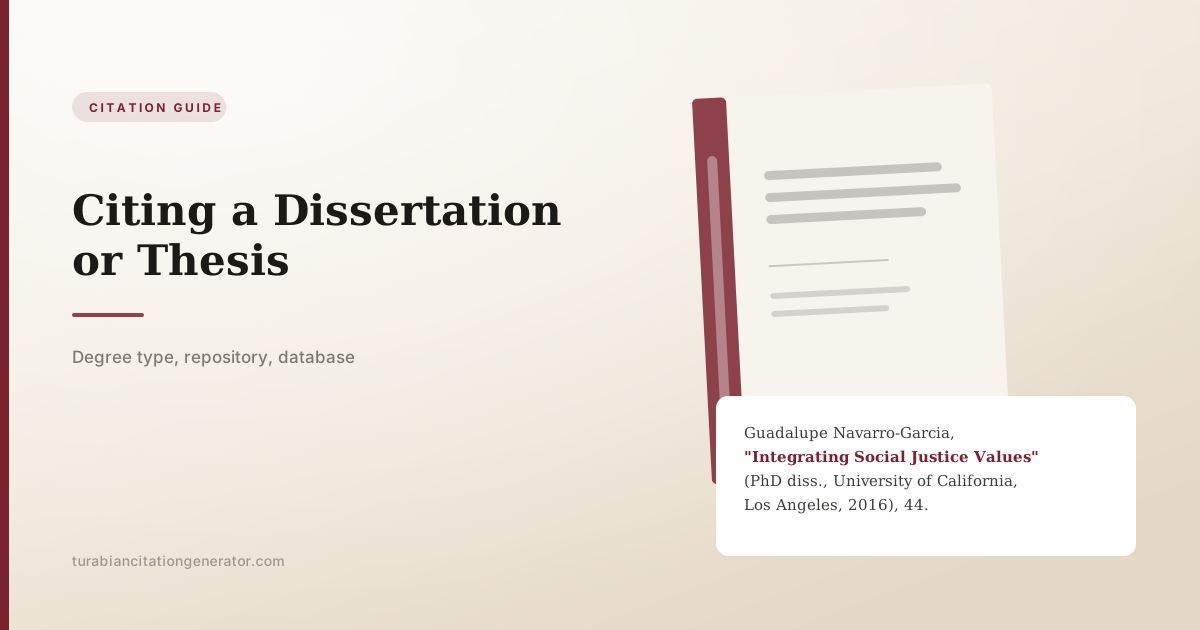
Cite a dissertation or thesis in Turabian with the author, the title in quotation marks (not italics), then the degree type, the awarding institution and the year in parentheses, followed by the page and the database or repository where you read it.
First footnote:
- Guadalupe Navarro-Garcia, “Integrating Social Justice Values in Educational Leadership: A Study of African American and Black University Presidents” (PhD diss., University of California, Los Angeles, 2016), 44, ProQuest Dissertations and Theses Global.
Shortened footnote:
- Navarro-Garcia, “Social Justice Values,” 125-26.
Bibliography entry:
Navarro-Garcia, Guadalupe. “Integrating Social Justice Values in Educational Leadership: A Study of African American and Black University Presidents.” PhD diss., University of California, Los Angeles, 2016. ProQuest Dissertations and Theses Global.
Author-date in-text citation:
(Navarro-Garcia 2016, 44)
Reference list entry:
Navarro-Garcia, Guadalupe. 2016. “Integrating Social Justice Values in Educational Leadership: A Study of African American and Black University Presidents.” PhD diss., University of California, Los Angeles. ProQuest Dissertations and Theses Global.
That is the pattern for the overwhelming majority of cases. Below: why the title is not italicized, how to word the degree for a master’s thesis or a foreign qualification, what changes between a database copy and a repository copy, and how to handle a dissertation you consulted in print or by microfilm.
The elements, in order
| Position | Element | Form |
|---|---|---|
| 1 | Author | First name first in notes, inverted in the bibliography |
| 2 | Title | Quotation marks, headline-style capitalization |
| 3 | Degree type | PhD diss., master’s thesis, and so on |
| 4 | Institution | The awarding university, as it names itself |
| 5 | Year | Year of the degree, not of the database record |
| 6 | Page | In notes only, for the passage you used |
| 7 | Source | Database name or URL, whichever applies |
In a note, items 3 to 5 sit together inside parentheses. In a bibliography entry they follow the title as an ordinary sentence element, with no parentheses. That is the same transformation that happens with a book’s publication facts, and it is worth checking every time, because it is easy to leave the parentheses in when copying a note into the bibliography. Our bibliography format guide sets out the full punctuation difference.
Why the title takes quotation marks
Italics signal a whole published work: a book, a journal, a film. Quotation marks signal a part, or a work that has not been formally published: an article, a chapter, a conference paper, a dissertation.
A dissertation is written for a degree committee rather than issued by a publisher, so Turabian treats it as unpublished regardless of how easy it is to find. A permanent URL, a DOI and a place in a commercial database do not change that. The degree, not the distribution, decides the formatting.
The exception is real but narrow. When a dissertation has been revised and issued by a publisher as a book, that book is a published work with a publisher, a place and an ISBN, and it takes italics like any other book.
Wording the degree
Write the degree the way the institution writes it, abbreviated in the conventional forms.
| Award | Descriptor to use |
|---|---|
| Doctor of Philosophy | PhD diss. |
| Doctor of Education | EdD diss. |
| Doctor of Ministry | DMin thesis, or as the institution words it |
| Doctor of Theology | ThD diss. |
| Master of Arts | master’s thesis |
| Master of Science | master’s thesis |
| Master of Theology | ThM thesis |
| Undergraduate honors work | honors thesis, or senior thesis |
Three points of care.
“Diss.” is short for dissertation and takes a period. “Master’s thesis” is spelled out, lowercase, with the apostrophe.
Naming conventions differ by country. In much of the United States the doctoral work is a dissertation and the master’s work is a thesis. In the United Kingdom and parts of the Commonwealth the doctoral work is often called a thesis. Follow the wording on the title page of the work you are citing rather than the convention you are used to.
Give the institution as it names itself, including the campus where that is part of the name: “University of California, Los Angeles” rather than “UCLA.”
Where you read it: database, repository, print
The last element of the citation tells your reader how to get the same copy. Give one route, not several.
A commercial database. Name the database, with no URL:
- Elias Kovac, “Freight Rates and Regional Prices in the Antebellum North” (PhD diss., Northgate University, 2021), 88, ProQuest Dissertations and Theses Global.
An institutional repository. Give the URL, preferring a permanent handle or DOI over a search-results link:
- Priya Raman, “Reading the Household Inventory: Material Culture in Colonial Madras” (PhD diss., Northgate University, 2023), 142, https://repository.example.edu/handle/12345.
A print copy consulted in a library. No database and no URL. If the copy is unusual or hard to find, name the library:
- Thomas Ellery, “Wage Books of the Staffordshire Potteries” (PhD diss., University of Keele, 1974), 61.
Microfilm or microfiche. Name the format where it helps a reader order the right item.
Examples above use illustrative details except where a real work is named.
The published and unpublished distinction, in practice
“Published” and “unpublished” cause more confusion here than anywhere else in Turabian, partly because older style guides used “unpublished dissertation” as a standing phrase.
Current practice is simpler. You do not need to write the word “unpublished” at all. The degree descriptor already tells the reader what kind of document this is. Adding “unpublished PhD diss.” is redundant, and it becomes actively misleading when the work is sitting in an open repository that anyone can download.
What matters is a different question: can your reader get this?
| Situation | Treatment |
|---|---|
| In a database or repository | Full citation, with the database or URL, and a bibliography entry |
| Held in a library, no digital copy | Full citation, no URL, and a bibliography entry |
| Embargoed, abstract only visible | Cite what you legitimately consulted; say so in your text |
| A draft the author sent you | Personal communication: note only, no bibliography entry |
The last case is the only one that leaves the bibliography. A manuscript shared privately cannot be retrieved by your reader, so it behaves like an email or a private interview.
Dissertations that became books
This is worth its own paragraph because the two versions are often substantially different documents. A revised book usually has a new argument in the introduction, reorganized chapters and a decade of additional scholarship in the notes.
Cite the version you read.
The dissertation:
- Priya Raman, “Reading the Household Inventory: Material Culture in Colonial Madras” (PhD diss., Northgate University, 2023), 142, https://repository.example.edu/handle/12345.
The book that came from it:
- Priya Raman, The Household Inventory: Material Culture in Colonial Madras (Chicago: University of Chicago Press, 2026), 98.
If the distinction matters to your argument, say so in your text: “Raman’s dissertation makes the claim more strongly than the published book does.” Do not try to compress that into the citation.
Repeat citations and page numbers
Shortened notes follow the normal Turabian pattern: surname, a short form of the title in quotation marks, and the page.
- Raman, “Household Inventory,” 87.
Keep the shortened title recognizable. “Raman, ‘Reading,’ 87” is too thin if your paper cites several works with similar openings. The rules behind this are covered in our guides to the shortened footnote and to citing the same source multiple times.
Page numbers work as they do for a book. If the copy you used has no stable pagination, cite a chapter or a section instead, and prefer a paginated PDF over a reflowable format where you have the choice.
Author-date treatment
The pattern moves the year forward and drops the parentheses around the publication facts:
Raman, Priya. 2023. “Reading the Household Inventory: Material Culture in Colonial Madras.” PhD diss., Northgate University. https://repository.example.edu/handle/12345.
The in-text citation gives the surname, the year and the page:
(Raman 2023, 142)
For multiple works by the same author in the same year, page-number conventions and the ordering of the reference list, see our Turabian author-date guide.
Where to find the details
Dissertation metadata is scattered, and database records are not always right. Three places to look, in order of reliability.
The dissertation’s own title page. This is authoritative for the title, the author’s name as they submitted it, the degree, the department and the institution. Open the PDF and look, rather than trusting the database’s summary fields.
The approval or signature page, usually the second or third page, which gives the degree and often the date of conferral. Where the database year and the title page year disagree, the document wins.
The database record, for the identifier and the stable link. Database records are useful for locating and unreliable for wording: they truncate long titles, normalize capitalization and sometimes list the department rather than the degree.
Two details are worth checking every time. The author’s name may appear in one form on the title page and another in the database; use the title page form. And the year may be the year of submission, the year of defence or the year of conferral, which can differ across a December graduation; take the year the title page gives.
Abstracts, non-English work and multi-volume theses
Citing only the abstract. If a dissertation is embargoed and you could read only the abstract, cite what you consulted and say so. Do not cite the full text you did not see:
- Priya Raman, abstract of “Reading the Household Inventory: Material Culture in Colonial Madras” (PhD diss., Northgate University, 2023), https://repository.example.edu/handle/12345.
Non-English dissertations. Give the title in its original language. A translation in square brackets after it helps a reader who does not read that language, and is conventional in humanities work:
- Élise Fontaine, “Le commerce du grain à Rouen, 1780-1830” [The grain trade in Rouen, 1780-1830] (PhD diss., Université de Rouen, 2019), 74.
Write the degree in the form used in your own paper’s language, since the descriptor is your description of the qualification rather than part of the title.
Multi-volume theses. Cite the volume with the page:
- Thomas Ellery, “Wage Books of the Staffordshire Potteries” (PhD diss., University of Keele, 1974), 2:61.
Theses with restricted access. Some repositories release metadata but not the file. If you obtained a copy directly from the author, cite the dissertation normally and note the source of your copy in your text, since your reader cannot follow the repository link to the full document.
Common mistakes
Italicizing the title. The most common error by a wide margin. Quotation marks.
Writing “Unpublished PhD dissertation.” Redundant, and often inaccurate.
Giving the database year instead of the degree year. The year is the year of the degree.
Adding both a database name and a URL. Pick the route you actually used.
Using an initialism for the university. Write the institution’s full name.
Linking to a search-results page. Use the permanent handle or DOI.
Citing the dissertation when you read the book. Or the reverse. Cite what you read.
Leaving it out of the bibliography. A retrievable dissertation belongs there.
Frequently asked questions
Is a dissertation title italicized in Turabian? No. It goes in quotation marks, because Turabian treats a dissertation as an unpublished work regardless of where it is hosted.
What is the difference between citing a dissertation and a thesis? None structurally. The template is the same; only the degree descriptor changes, and you should follow the wording the institution uses.
Do I include the database name? Yes, when that is where you read it, in the position a URL would take. Give the database or the URL, not both.
How do I cite a dissertation that was later published as a book? Cite whichever version you actually read. The two often differ substantially.
Does a dissertation go in the bibliography? Yes, when it is retrievable. Only a privately shared draft is treated as a personal communication and kept out.
If you are writing one, not just citing one
A thesis or dissertation of your own is governed by your graduate school’s template, which outranks the general Turabian rules on front matter. The two pages most often sent back for revision are the title page and the table of contents; our guides to the Turabian title page and the Turabian table of contents cover both, with the caveat that an official template always wins.
For the citations inside it, enter the author, title, institution and year into the Turabian Citation Generator and copy out the note and bibliography forms.