How to Cite the Bible in Turabian: Footnote, In-Text Citation & Examples
Cite the Bible in Turabian with book, chapter and verse plus the translation, and keep it out of the bibliography. Abbreviations, examples and study Bibles.
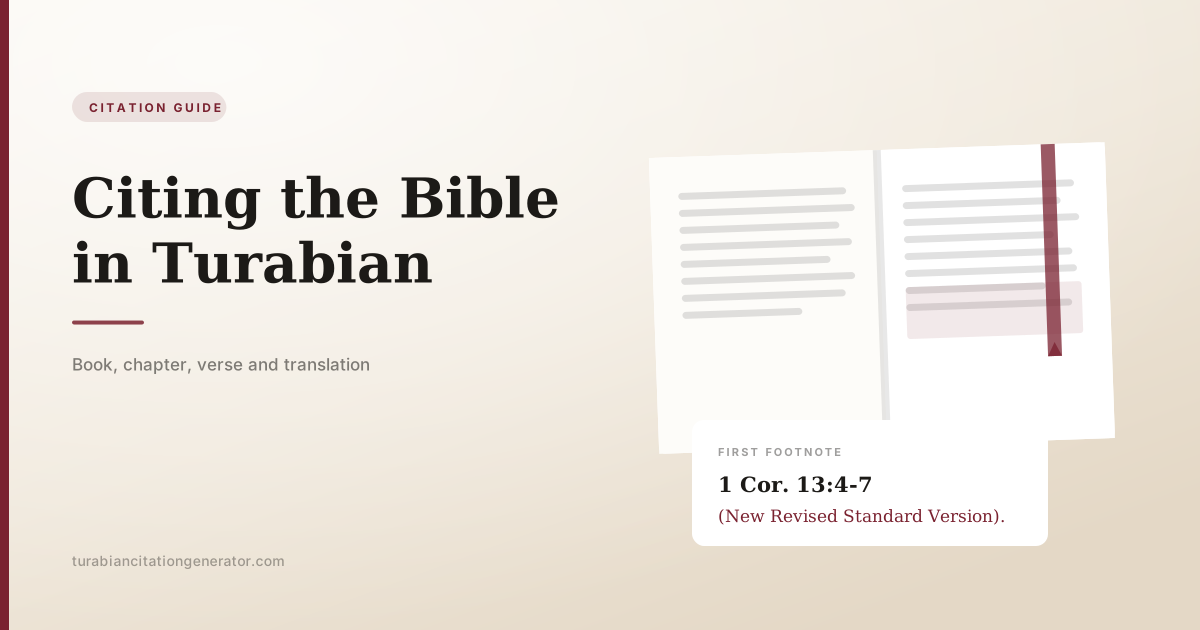
Cite the Bible in Turabian with the abbreviated book name, the chapter, a colon and the verse, followed by the translation on the first citation. Scripture goes in a footnote or a parenthetical reference and is left out of the bibliography, because readers can locate a verse in any edition.
First footnote:
- 1 Cor. 13:4-7 (New Revised Standard Version).
Later footnote, same translation:
- Rom. 8:28.
Author-date in-text citation:
(1 Cor. 13:4-7 NRSV)
Bibliography entry: none. Scripture is not listed.
The rest of this page covers the abbreviation sets Turabian offers, how versions are handled when you use more than one, when a scriptural citation is written out in full, how study Bibles and online Bibles differ from plain scripture, and the mistakes that cost marks in theology and history courses.
Why the Bible is not cited like an ordinary book
A standard Turabian note for a book gives the author, title, place, publisher, year and page, because that is what a reader needs to find the exact copy you used. Scripture does not work that way. Genesis 1:1 is Genesis 1:1 in every printing, in every publisher’s edition, in every library.
So Turabian drops the publication apparatus and cites the text by its own internal address: book, chapter, verse. What a reader does need is the translation, because wording differs between versions and your argument may depend on it. That is why the version appears and the publisher does not.
The consequence follows directly: with no publication facts and no page numbers, there is nothing to alphabetize into a bibliography, so scripture stays out of it. This is the single rule students most often get wrong.
The three parts of a scriptural citation
Book. Abbreviated in citations, spelled out in running prose.
Chapter and verse. Arabic numerals, separated by a colon, with no spaces: 4:11. A verse range takes an en dash or hyphen: 5:2-5. Non-consecutive references are separated by commas: 1 Thess. 4:11, 5:2-5, 5:14.
Translation. Named on the first citation, then omitted unless you change versions.
No page numbers appear, ever. Page numbers belong to a particular printing, and the whole point of chapter and verse is that they do not.
| Element | Form | Example |
|---|---|---|
| Single verse | Book chap:verse | John 3:16 |
| Verse range | Book chap:verse-verse | Rom. 8:28-30 |
| Several verses, same book | Comma between references | 1 Thess. 4:11, 5:2-5 |
| Whole chapter | Book and chapter only | Ps. 23 |
| Two chapters | En dash between chapters | Gen. 1-2 |
| Whole book | Spelled out, no numbers | the book of Job |
Abbreviations: two sets, pick one
Turabian supplies two sets of abbreviations for the books of the Bible, and both are acceptable. What is not acceptable is mixing them.
Traditional abbreviations use periods: Gen., Exod., Lev., Num., Deut., Josh., Judg., 1 Sam., 2 Kings, Ps., Prov., Isa., Jer., Ezek., Dan., Matt., Mark, Luke, John, Acts, Rom., 1 Cor., 2 Cor., Gal., Eph., Phil., Col., 1 Thess., 1 Tim., Heb., James, 1 Pet., 1 John, Rev.
Shorter abbreviations drop the periods: Gen, Exod, Lev, Num, Deut, Josh, Judg, 1 Sam, 2 Kgs, Ps, Prov, Isa, Jer, Ezek, Dan, Matt, Mark, Luke, John, Acts, Rom, 1 Cor, Gal, Eph, Phil, Col, 1 Thess, 1 Tim, Heb, Jas, 1 Pet, 1 John, Rev.
The shorter set is common in biblical studies, where citations are dense and the periods add clutter. The traditional set is common in history and general humanities work. Biblical studies programs and journals frequently mandate one of them, so check before you commit.
Three books have names short enough that they are not abbreviated in either set: Mark, Luke, John, and in practice Acts and Ezra as well.
When to spell the book name out
Abbreviations belong inside citations. In three situations you write the name in full:
At the start of a sentence. Numbered books are spelled out as ordinals: “First Corinthians 13 is the passage most often read at weddings,” not “1 Cor. 13 is…”.
When you name a book without citing verses. “The book of Revelation closes the canon,” not “Rev. closes the canon.”
In running prose where the abbreviation would read awkwardly. “Paul returns to the theme in Romans” is better than “Paul returns to the theme in Rom.”
Naming the translation
Identify the version the first time you cite scripture in the paper. Spell it out on that first appearance, then use the abbreviation:
- Mic. 6:8 (New International Version).
- Isa. 40:31 (NIV).
Once established, the version can be dropped entirely for later citations in the same translation:
- Isa. 40:31.
If you use more than one translation, name each one the first time it appears, and mark every citation thereafter so the reader always knows which text is in front of them:
- Gen. 1:1 (New Revised Standard Version).
- Gen. 1:1 (King James Version).
- Ps. 23:1 (NRSV).
- Ps. 23:1 (KJV).
Common abbreviations you will meet: NRSV, NRSVue, NIV, ESV, KJV, NKJV, NASB, RSV, NLT, CEB, JPS, NAB, NABRE.
A note on punctuation
Guides differ slightly on how the version is attached. Parentheses after the verse are the most widely used form and follow the Chicago pattern:
1 Cor. 13:4 (NRSV)
Some departments, particularly in biblical studies, prefer the version after a comma or a space with no parentheses:
1 Cor. 13:4 NRSV
Both appear in reputable university guides, and Turabian’s own guidance is not framed as a single rigid template. Follow your department’s style sheet if it names one, and otherwise pick the parenthetical form and stay consistent.
Notes-bibliography examples
First note in the paper:
- Eccles. 3:1-8 (New Revised Standard Version).
Later notes:
- Eccles. 3:11.
- Job 38:4-7.
Several references in one note:
- 1 Thess. 4:11, 5:2-5, 5:14.
A note that also carries commentary:
- Amos 5:24 (NRSV). The prophetic literature returns to this image repeatedly.
Bibliography: nothing. Do not create an entry for the Bible, and do not invent one for a translation.
There is one common departmental exception: a few programs ask students to list the specific translation used, on the grounds that the choice of version is itself an argument. That is a local requirement rather than a Turabian rule, and it should be followed only when it is actually stated.
Author-date examples
Turabian’s author-date system handles scripture the same way, with the citation in parentheses in your text:
Paul’s description of love as patient and kind (1 Cor. 13:4 NRSV) has been read as a corrective to the Corinthian factionalism described earlier in the letter.
The formula appears three times in the chapter (Eccles. 3:1, 3:11, 3:15).
The reference list gets no entry, so a scriptural parenthetical never points at anything at the back of the paper. That is expected, and it is the one place where an author-date parenthetical legitimately has no matching entry. For everything else the reference list does contain, see our Turabian author-date guide.
Moving from notes to parentheses in the same paper
Theology and biblical studies papers often cite scripture on almost every page. A footnote for each reference produces a page that is more note than text, and most departments accept a practical compromise: give a full note the first time, then switch to parenthetical references in your running text.
The prophet’s demand is unambiguous.¹ Later in the same chapter the imagery shifts from justice to abundance (Amos 5:24; 9:13).
- Amos 5:24 (New Revised Standard Version).
Three points make this work. Establish the translation in the first note, so the parentheses that follow do not need to repeat it. Keep the parenthetical inside the sentence’s closing punctuation, as you would with any in-text citation. And be consistent: do not alternate between notes and parentheses for scripture without a reason a reader can see.
This is a convention rather than a fixed rule, and it varies by department. Biblical studies programmes frequently prefer parentheses throughout after the first note; history programmes citing scripture occasionally often prefer notes throughout. Ask, and then hold to whichever you are told.
Study Bibles, commentaries and introductions
Here is the distinction that separates a correct citation from an incorrect one: are you citing scripture, or are you citing something a scholar wrote about scripture that happens to be printed in the same volume?
Scripture is cited by book, chapter and verse, with no bibliography entry. Editorial matter is cited like a chapter in an edited book, and it does go in the bibliography.
Note for a study Bible’s editorial note or book introduction:
- Ronald Hendel, “Genesis,” in The HarperCollins Study Bible, ed. Harold W. Attridge and Wayne A. Meeks (New York: HarperOne, 2006), 4.
Shortened note:
- Hendel, “Genesis,” 12.
Bibliography entry:
Hendel, Ronald. “Genesis.” In The HarperCollins Study Bible, edited by Harold W. Attridge and Wayne A. Meeks, 3-82. New York: HarperOne, 2006.
The same logic covers a commentary volume, a Bible dictionary entry and a translator’s preface. If a named person wrote it and it appears on a numbered page, it is ordinary published scholarship and it follows ordinary rules, including the hanging indent and alphabetical placement described in our Turabian bibliography format guide.
Online Bibles
Reading a verse on a website does not change the citation. Chapter and verse locate the text regardless of where you read it, so an online Bible is still cited as:
- Ps. 46:1 (ESV).
You do not need a URL, an access date or the website’s name for the scriptural text itself.
Two situations do call for more. If you are citing a website’s own content, such as an article, a translation note or a search tool, that is website content and takes a normal web citation with the site name, date and URL. And if you are analyzing a digital edition as an artifact, for example arguing about how a particular app presents variant readings, then the edition itself is your source and should be described fully.
Apocrypha, deuterocanonical books and other sacred texts
Books outside the Protestant canon are cited in exactly the same shape, using their own standard abbreviations: Tob., Jth., Wis., Sir., Bar., 1 Macc., 2 Macc. Because their inclusion and ordering differ between traditions, naming the version matters even more than usual.
Other sacred works follow the same principle. A Qur’anic reference is given by surah and verse, and classic religious texts with their own internal numbering systems use that numbering rather than page numbers. As with the Bible, these are cited in notes or parentheses and generally kept out of the bibliography.
Common mistakes
Putting the Bible in the bibliography. The most frequent error, and the easiest to fix.
Adding a page number. “Gen. 1:1, 3” makes no sense; chapter and verse are the location.
Using a period instead of a colon. It is 3:16, not 3.16, in Turabian.
Mixing abbreviation sets. “Gen.” in one note and “Gen” in the next looks careless. Choose one.
Never naming the translation. If your reader cannot tell which version you quoted, they cannot check your reading of the wording.
Repeating the translation in every note. After the first citation, drop it unless you switch versions.
Abbreviating at the start of a sentence. Write “First Peter 2:4,” not “1 Pet. 2:4,” when it opens the sentence.
Citing a study Bible note as scripture. A named scholar’s commentary is published scholarship, and it belongs in the bibliography.
Frequently asked questions
Does the Bible go in a Turabian bibliography? No. Scripture is cited in a footnote or a parenthetical reference and left out of the bibliography and the reference list. A specific published edition you are analyzing, such as a study Bible with editorial notes, is cited like an edited book and does appear.
Do I abbreviate the book of the Bible? Yes, in citations. Turabian gives a traditional set with periods (Gen., Matt., 1 Cor.) and a shorter set without them (Gen, Matt, 1 Cor). Use one set consistently, and spell the name out when it opens a sentence or refers to the whole book.
Where does the translation go? After the verse numbers, on the first scriptural citation in the paper. Spell it out the first time, then abbreviate. Name it again only when you switch translations.
How do I cite the Bible in Turabian author-date style? Put the abbreviated book, chapter and verse in parentheses in your text and identify the translation the first time. Scripture is still omitted from the reference list.
How do I cite a study Bible note or introduction? As a chapter in an edited book: contributor, title of the note in quotation marks, study Bible title in italics, editors, publication details and page. That citation does belong in the bibliography.
Putting it together
Two rules carry almost all of this. Cite scripture by book, chapter and verse rather than by page, and name the translation once so your reader knows which wording you are working from. Everything else is consistency: one abbreviation set, one punctuation pattern, no bibliography entry.
For the commentaries, study Bibles and monographs that surround your scriptural work and do need full entries, gather the author, title, editors, publisher and year and let the Turabian Citation Generator build the note and bibliography entry.