Turabian Shortened Footnote: Full Note vs Short Note
A Turabian shortened footnote goes in every note after the first. See full note vs short note side by side, with copy-ready examples in Turabian 9th style.
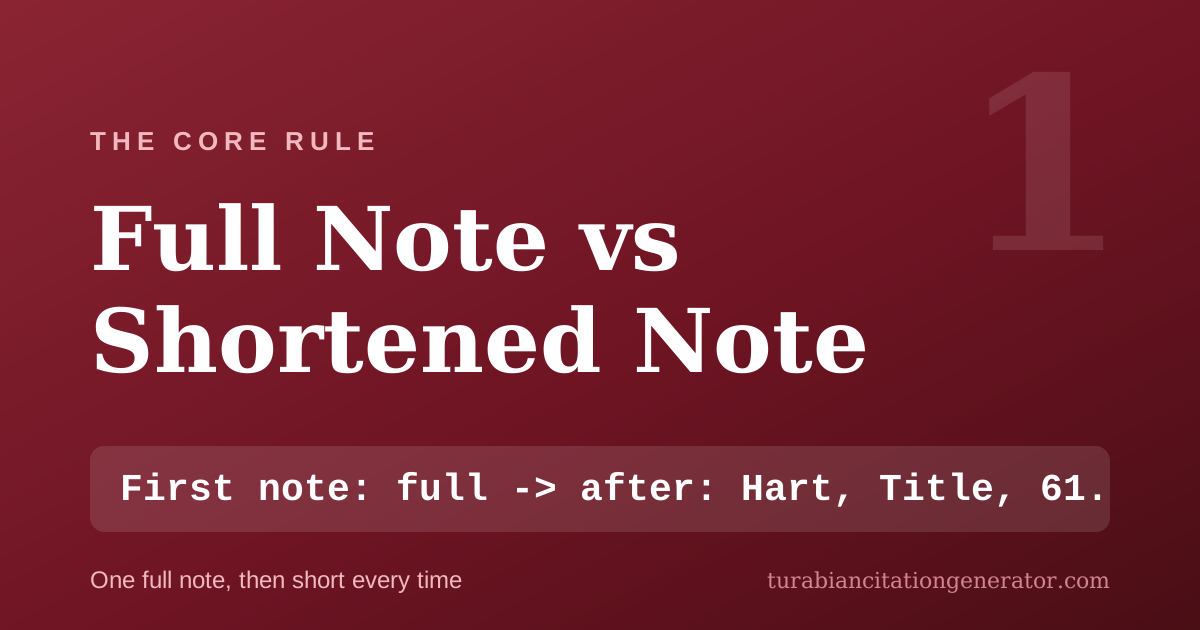
The rule is short: the first time you cite a source, use a full note; every time after that, use a Turabian shortened footnote. That one line saves you from repeating a long publisher block over and over, and it keeps your notes clean. If you’d rather not track which form goes where, the free Turabian footnote generator builds both the full and shortened versions for you.
This guide covers Turabian 9th edition (based on Chicago 17th). It shows the full note vs short note difference for books, journal articles, websites, and chapters, plus how to shorten a long title without making it ambiguous.
What a Turabian shortened footnote actually is
A shortened note is a trimmed version of the full citation. It carries just enough to point a reader to the right entry in your bibliography, then to the right page. Nothing more.
You keep three things: the author’s last name, a shortened title, and the page number. You drop the publication facts, because the full note (and the bibliography) already give them. This is the “turabian full note vs short note” split in one sentence.
The punctuation matters too. A comma separates the author from the title and the title from the page, and the note ends with a period. Turabian 9th uses this exact spacing every time, so once you match it for one source, the rest follow the same shape.
Try it: build a Turabian footnote automatically instead of formatting it by hand.
Full note vs short note: what each one holds
| Element | Full note (first time) | Shortened note (after) |
|---|---|---|
| Note number | Yes | Yes |
| Author | Full name, first then last | Last name only |
| Title | Full title, subtitle included | Key words only, subtitle dropped |
| Publisher / city | Yes | No |
| Year | Yes | No |
| Page number | Yes | Yes |
Read the table as a subtraction problem. Start with the full note, remove the first name, the subtitle, and the whole publication block, and you’re left with the shortened citation. Turabian keeps this format across the notes-bibliography system, so the same pattern holds whether the source is a book or a web page.
The same source, both ways, across four source types
Below is each source shown as a Full note, a Shortened note, and (where it has one) a Bibliography entry. Copy the single line you need. Notice how the shortened form stays consistent even as the full note changes shape.
Book (one author)
Full note
- Eleanor Hart, The Reforming Century (Chicago: University of Chicago Press, 2015), 52.
Shortened note
2. Hart, Reforming Century, 61.
Bibliography
Hart, Eleanor. The Reforming Century. Chicago: University of Chicago Press, 2015.
Journal article
Full note
- Susan Blackwood, “Reading the Margins,” Journal of Medieval History 42, no. 3 (2016): 210.
Shortened note
2. Blackwood, “Reading the Margins,” 213.
Bibliography
Blackwood, Susan. “Reading the Margins.” Journal of Medieval History 42, no. 3 (2016): 205–28.
For an article, the shortened note keeps the title in quotation marks and swaps the full volume-and-issue block for a single page. The title here is already short, so it stays whole.
Website / web page
Full note
- Maria Torres, “Preserving Colonial Archives,” National History Center, March 3, 2019.
Shortened note
2. Torres, “Preserving Colonial Archives.”
Bibliography
Torres, Maria. “Preserving Colonial Archives.” National History Center. March 3, 2019.
A web page usually has no page number, so the shortened note ends after the title. Don’t force a page onto a source that doesn’t have one.
Chapter in an edited book
Full note
- Daniel Okoro, “Trade Routes of the Sahel,” in Empires of the Desert, ed. Priya Nair (New York: Oxford University Press, 2018), 143.
Shortened note
2. Okoro, “Trade Routes of the Sahel,” 147.
The shortened note drops the editor, the book title, and the publisher. You cite the chapter author and the chapter title, since that’s what your reader is looking for.
How to shorten a long title correctly
Most titles need trimming, and there’s a method. Keep the key noun phrase that identifies the work. Drop the initial article (“The,” “A,” “An”) and drop the subtitle that follows the colon.
Here’s a worked before and after:
The Reforming Century: Faith and Politics in Early America → Reforming Century
The article “The” goes, and everything after the colon goes. What’s left is short but still recognizable. One caution: keep enough words to identify the work uniquely. If your author wrote two books that both start with the same word, hold on to whatever word separates them so the reader isn’t guessing.
Titles in quotation marks (articles, chapters, web pages) follow the same logic, but they’re often short already, so you may keep them whole, as in the Blackwood and Torres examples above.
Shortened notes when there are multiple authors
The author part of a shortened note depends on how many authors the source has.
- Two or three authors: list all of their last names.
- Four or more authors: use the first author’s last name followed by “et al.”
For two authors, the full note reads:
Full note (two authors)
- Eleanor Hart and James Cole, The Reforming Century (Chicago: University of Chicago Press, 2015), 88.
Shortened note (two authors)
2. Hart and Cole, Reforming Century, 90.
Three authors follow the same rule as two: name all of them. If Hart, Cole, and a third author wrote the book, the shortened note lists all three last names, then the short title and page. Don’t shorten three names to “et al.”; that threshold starts at four.
For a source with four or more authors, the full note already uses “et al.,” and the shortened note keeps it:
Full note (four or more authors)
- Priya Nair et al., Coastal Economies (Boston: Harbor Press, 2020), 30.
The shortened version of that source would be Nair et al., Coastal Economies, plus a page. Whatever the author count, the shortened note mirrors how the full note handled the names. Set the names once in the full note and every later short note copies that same pattern.
How the shortened note works with your bibliography
A shortened note is not a replacement for the bibliography. It’s a pointer to it. Your bibliography still holds the full entry for the source, alphabetized by the author’s last name, with a hanging indent.
So a reader who sees Hart, Reforming Century, 61 in a note can flip to the bibliography, find Hart, Eleanor. The Reforming Century…, and get the complete publication details. That division of labor is why the shortened note can afford to be so brief. The generator produces the matching bibliography entry alongside your notes, so the two always line up.
One more habit helps: when you cite the same book several times, each shortened note carries the page for that citation. Cite page 61 in one note and page 90 later, and the two shortened notes are identical except for the page. The short title stays fixed; only the page moves. This is how a paper can reference a single source a dozen times without repeating a full citation once.
Turabian’s own quick guide confirms this notes-plus-bibliography pairing and shows the same short-form pattern.1
”Which do I use here?” A quick walkthrough
When you hit a footnote and aren’t sure which form to use, run these steps in order:
- Ask: have I cited this exact source anywhere earlier in the paper? Check every earlier note, not just the one right above.
- If no, this is the first mention. Write a full note with author, full title, publication facts, and page.
- If yes, write a shortened note: last name(s), short title, page.
- Set the page number to the page you’re citing now, not the page from the earlier note.
- If the earlier note is the one directly above and cites this same single source, you may instead use a shortened note (Turabian 9th prefers this) or “Ibid.” if your instructor still accepts it.
Here’s the walkthrough in action. Say note 4 is your first mention of Blackwood’s article, so it’s a full note. Note 9 cites Blackwood again, but three other sources came between them. Note 9 is a shortened note, because the source already appeared earlier, even though it wasn’t the note right before. That gap is exactly why shortened notes exist and “Ibid.” often doesn’t fit.
That back-to-back case is its own small topic. For when the same source appears in consecutive notes, see when to use Ibid. in Turabian.
Where shortened notes go wrong
Shortening the first note. The first citation of a source must be full. If your reader meets Hart, Reforming Century, 61 with no earlier full note, they have no publication details to fall back on. Full note first, always.
Over-shortening the title. Trim to the key words, but not past the point of recognition. Reforming alone is too vague; Reforming Century is right. If a shortened title could name two different works, it’s too short.
Dropping the page number. The page is the whole reason for a note that points to a book or article. A shortened note without a page (when the source has pages) tells the reader which source but not where. Keep it.
Mixing name forms. In a shortened note the author is last name only, never “Eleanor Hart.” And for two or three authors, don’t collapse to “et al.”; list every last name.
Italicizing the wrong part. Book titles stay italic in the shortened note (Reforming Century). Article, chapter, and web-page titles stay in quotation marks (“Reading the Margins”). Shortening a title never changes whether it’s italic or quoted; it only cuts words.
If you’d rather skip the manual checks, a Turabian footnote tool applies these rules for you. For the broader picture of how footnotes are numbered and placed, start with the full guide to Turabian footnotes.
Shortened note questions, answered
When do I use a shortened citation in Turabian? Use a shortened citation every time you cite a source after the first. The first note is full; the second, third, and all later notes for that source are shortened.
What goes in a Turabian shortened footnote? Three parts: the author’s last name, a shortened title, and the page number. You leave out the first name, the subtitle, and all publication facts like city, publisher, and year.
Do I still need a bibliography if I use shortened notes? Yes. Shortened notes rely on the bibliography (or the earlier full note) for the complete details. Keep the full bibliography entry, alphabetized by last name.
How short should the title be? Keep the key noun phrase, drop the leading article, and cut the subtitle after the colon. Leave enough to tell the work apart from anything else by the same author.
Is a shortened note the same as “Ibid.”? No. A shortened note can refer to any earlier citation of a source. “Ibid.” refers only to the note directly above it. Turabian 9th prefers the shortened note, though some instructors still accept “Ibid.”
The rule worth memorizing
Full note first, shortened note forever after. Once that click happens, most of the work is just trimming: last name, short title, page. When you want the exact punctuation and italics handled automatically, use the Turabian citation generator to produce the full note, the shortened note, and the bibliography entry together, then paste the line you need.
1 The University of Chicago Press, “Turabian: Notes and Bibliography Citation Quick Guide,” accessed July 20, 2026, https://www.chicagomanualofstyle.org/turabian/turabian-notes-and-bibliography-citation-quick-guide.html.